
한국어scime atlas / Paid reports / Country and government
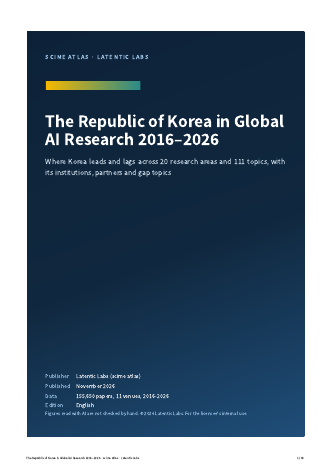
The Republic of Korea in Global AI Research 2016–2026
Where Korea leads and lags across 20 research areas and 111 topics, with its institutions, partners and gap topics
PublisherLatentic Labs (scime atlas)
PublishedNovember 24, 2026
Length43 pages
SKULL-ATL-2601
FormatPDF · Available in English and Korean.
Key findings
- Between 2016 and 2026, 6,408 papers at the eleven leading AI venues had at least one author at a Korean institution, and Korea's output grew 1.9× from 2021–2023 to 2024–2026.
- In 2024–2026 Korea took part in 5.9% of the papers whose affiliations are known (5.3% in 2021–2023), sixth among countries after China, the United States, Hong Kong, the United Kingdom and Singapore.
- Korea's strongest areas relative to its overall share are image generation (1.51×), 3D vision (1.34×), architectures and efficiency (1.33×) and continual learning (1.31×).
- Its weakest large areas are learning theory and algorithms (0.38×), graph learning (0.67×), optimization (0.70×) and adversarial robustness and security (0.71×).
- Fast-growing topics where Korea's share is lowest include AI and society, causal discovery, cooperative multi-agent RL, and LLM agents for code and math.
From the report's executive summary. The full report has the tables, figures and profiles behind each finding.
Description
Korea's AI research output at the eleven leading AI venues grew 1.9× between 2021–2023 and 2024–2026, but its strengths are uneven. This report measures Korea's share in each of 20 research areas and 111 topics against the world's growth, names the Korean institutions that lead each area, and lists the fast-growing topics where Korea is under-represented.
In this report
- Where Korea leads and lags. A specialization index for every research area shows where Korea publishes more, or less, than its overall share, set against how fast each area grows worldwide.
- Countries compared. Papers and shares of the leading countries from 2016 to 2026, and how much of each country's work is international.
- Gap topics and opportunities. Fast-growing topics and approaches in which Korean institutions are thin: candidates for new programs.
Report scope and segments
- By research area: 20 areas, each with its topics, Korea's share, leading Korean institutions and leading countries
- By country: the 15 countries with the most papers, plus Korea
- By institution: the 30 Korean institutions with the most papers
- By venue: ICML, NeurIPS, ICLR, CVPR, AAAI, ICCV, ECCV, EMNLP, TPAMI, IJCV, JMLR
- By period: 2016–2026, with 2021–2023 and 2024–2026 compared
Who this report is for
Government ministries and agencies, research funders, regional governments, national R&D planners.
Table of contents
43 pages
1 Executive summary
2 About this report
3 Data and methodology
3.1 Data sources
3.2 Authors' institutions
3.3 Countries
3.4 Results read from the full text
3.5 Limitations
4 The global AI research landscape
4.1 Growth of the field
4.2 Research areas
4.3 Fastest-growing topics
5 Countries compared
5.1 Papers by country
5.2 International collaboration
6 Korea at a glance
6.1 Papers and share over time
6.2 By venue
6.3 Leading Korean institutions
7 Strengths and weaknesses by research area
7.1 Korea's share in each area
8 Area profiles
8.1 Large language models
8.2 Vision-language and multimodal
8.3 Image generation
8.4 Label-efficient and robust learning
8.5 3D vision
8.6 Architectures and efficiency
8.7 Video
8.8 Probabilistic and scientific modeling
8.9 Learning theory and algorithms
8.10 Reinforcement learning
8.11 Multi-agent systems and games
8.12 Detection and segmentation
8.13 Graph learning
8.14 Adversarial robustness and security
8.15 Optimization
8.16 Federated learning and privacy
8.17 Point clouds
8.18 Time series
8.19 Continual learning
8.20 Bandits and online learning
9 Gap topics and opportunities
9.1 Fast-growing topics where Korea is under-represented
9.2 Approaches to watch
10 Collaboration
10.1 Partner countries
10.2 Foreign partner institutions
11 Implications for R&D planning
12 Appendix: research areas and topics
List of figures
Figure 1 Korea's share of papers with known affiliations, 2016–2026
Figure 2 Accepted papers per year by venue, 2016–2026
Figure 3 Accepted papers per year, all eleven venues
Figure 4 Share of the six largest areas, 2016–2026
Figure 5 Share of papers by country, 2016–2026 (papers with known affiliations)
Figure 6 Papers with a Korean institution per year
Figure 7 Korea's share of papers with known affiliations
Figure 8 Fifteen leading Korean institutions, 2024–2026
Figure 9 World growth and Korea's specialization by area
Figure 10 Large language models: Korea's share over time
Figure 11 Vision-language and multimodal: Korea's share over time
Figure 12 Image generation: Korea's share over time
Figure 13 Label-efficient and robust learning: Korea's share over time
Figure 14 3D vision: Korea's share over time
Figure 15 Architectures and efficiency: Korea's share over time
Figure 16 Video: Korea's share over time
Figure 17 Probabilistic and scientific modeling: Korea's share over time
Figure 18 Learning theory and algorithms: Korea's share over time
Figure 19 Reinforcement learning: Korea's share over time
Figure 20 Multi-agent systems and games: Korea's share over time
Figure 21 Detection and segmentation: Korea's share over time
Figure 22 Graph learning: Korea's share over time
Figure 23 Adversarial robustness and security: Korea's share over time
Figure 24 Optimization: Korea's share over time
Figure 25 Federated learning and privacy: Korea's share over time
Figure 26 Point clouds: Korea's share over time
Figure 27 Time series: Korea's share over time
Figure 28 Continual learning: Korea's share over time
Figure 29 Bandits and online learning: Korea's share over time
Figure 30 Countries co-authoring with Korean institutions, 2024–2026
List of tables
Table 1 Summary: Korea's six strongest and four weakest areas
Table 2 Venues and papers in the data
Table 3 Share of papers with known affiliations, by venue and year
Table 4 Papers by research area, 2021–2023 and 2024–2026
Table 5 Twenty fastest-growing topics (at least 300 papers in 2024–2026)
Table 6 Papers with at least one author in each country
Table 7 Papers with a Korean institution by venue
Table 8 Thirty Korean institutions with the most papers, 2024–2026
Table 9 Korea's share and specialization index by area
Table 10 Large language models: topics, growth and Korea's share
Table 11 Vision-language and multimodal: topics, growth and Korea's share
Table 12 Image generation: topics, growth and Korea's share
Table 13 Label-efficient and robust learning: topics, growth and Korea's share
Table 14 3D vision: topics, growth and Korea's share
Table 15 Architectures and efficiency: topics, growth and Korea's share
Table 16 Video: topics, growth and Korea's share
Table 17 Probabilistic and scientific modeling: topics, growth and Korea's share
Table 18 Learning theory and algorithms: topics, growth and Korea's share
Table 19 Reinforcement learning: topics, growth and Korea's share
Table 20 Multi-agent systems and games: topics, growth and Korea's share
Table 21 Detection and segmentation: topics, growth and Korea's share
Table 22 Graph learning: topics, growth and Korea's share
Table 23 Adversarial robustness and security: topics, growth and Korea's share
Table 24 Optimization: topics, growth and Korea's share
Table 25 Federated learning and privacy: topics, growth and Korea's share
Table 26 Point clouds: topics, growth and Korea's share
Table 27 Time series: topics, growth and Korea's share
Table 28 Continual learning: topics, growth and Korea's share
Table 29 Bandits and online learning: topics, growth and Korea's share
Table 30 Gap topics: fast growth, low Korean share
Table 31 Twenty-five fastest-growing approaches and Korea's papers in them
Table 32 Twenty foreign institutions most often co-authoring with Korea, 2024–2026
Table 33 The 20 research areas and their topics